
If you are still relying on basic keyword matching to find your next lead developer, you are essentially hiring for 2021 in a 2026 market. It’s exhausting to sift through a high volume of irrelevant CVs from generalist agencies whilst your top-tier candidates are being headhunted by faster-moving competitors. You likely feel the sting of ghosting in this talent-short market and worry about the long-term impact of a poor cultural fit. We understand that software engineering recruitment isn’t just about filling a seat; it’s about building a resilient, high-performing team that stays.
This guide will help you master the complexities of sourcing, vetting, and retaining elite engineering talent within the evolving UK tech landscape. You’ll learn how to move beyond reactive hiring to build a streamlined process that secures passive talent and reduces churn. We will examine the shift towards technical partnership, the necessity of simultaneous code and culture vetting, and the practical steps to ensure your organisation remains a first-choice employer for the best engineers in the country.
Key Takeaways
- Learn why treating software engineering recruitment as a strategic business function is essential for navigating the “Full-Stack + Niche” requirements of the current UK market.
- Implement a dual-track “Code and Culture” vetting process to move beyond unreliable keyword matching and secure candidates who truly fit your team.
- Determine when to prioritise the long-term ROI of permanent hires versus the agility of contract recruitment for specific digital shifts.
- Discover the headhunting methodologies used to engage the 70% of elite engineering talent that remains passive and invisible on standard job boards.
- Understand the value of partnering with TrustTech Recruitment as a specialist guide to ensure precision and cultural alignment in every hire.
The Landscape of Software Engineering Recruitment in 2026
Software engineering recruitment has shifted from a transactional HR task to a core strategic lever. In 2026, your engineering team is the engine of your business, not just a cost centre. Treating hiring as a simple exercise to fill a gap often leads to technical debt and cultural friction. We see the most successful UK firms viewing talent acquisition as a long-term investment in their technical architecture. They understand that a single elite hire can often outperform an entire team of average developers.
To ensure your current developers can also reach this elite level, investing in structured professional development is vital; to explore the programmes offered by Trainetics Academy, click here.
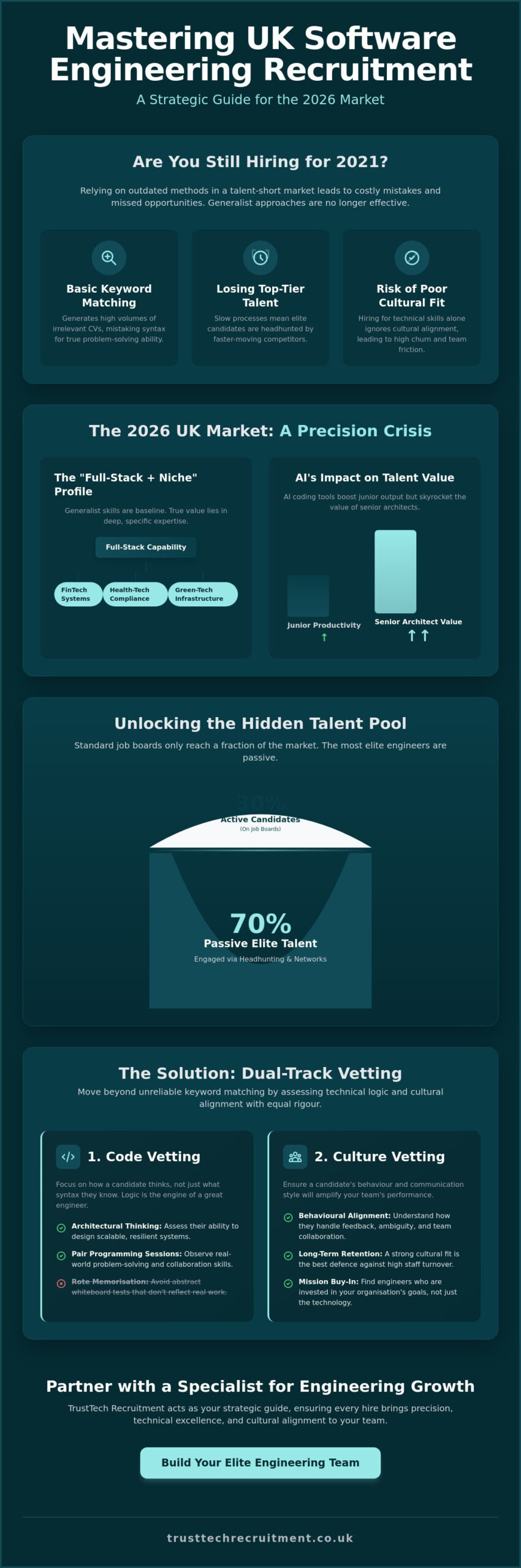
The UK market now demands a “Full-Stack + Niche” profile. It’s no longer sufficient to find a developer who understands React or Node. Candidates need deep, specific expertise in areas like high-frequency trading systems, healthcare data compliance, or the complex control systems for an electric wheelchair UK. This shift makes the generalist recruitment model obsolete. Generalist agencies often struggle to distinguish between a competent coder and a true specialist because they lack the technical depth to vet for these specific nuances. They provide volume when you actually need precision. Identifying the right technical recruitment consultants UK businesses can rely on is now a strategic necessity for any organisation looking to scale without the friction of mismatched talent.
AI-assisted coding tools have fundamentally changed how we evaluate talent. Whilst these tools can boost a junior developer’s productivity, they’ve also created a glut of entry-level candidates who can generate code but struggle to architect complex systems. Consequently, the value of senior engineers has skyrocketed. These seniors aren’t just writing code; they’re reviewing AI-generated outputs and ensuring system integrity. This trend is visible even amongst those with a formal education in software engineering, as the focus shifts from syntax to systemic design and security.
Current Market Dynamics and Talent Shortages
The scarcity of senior-level engineers remains acute despite the rise of automated tools. Hybrid work models have expanded your reach across the UK, but they’ve also forced you to compete with London-level salaries regardless of your office location. In a market where top candidates often hold three or more competing offers, your employer brand is your most powerful tool. To help build this visibility within the industry, you can learn more about BCM Public Relations and their specialist PR planning for the engineering and technology sectors. It’s the difference between a candidate choosing your mission or being swayed by a faster-moving competitor who offers a slightly more streamlined interview process.
The Evolution of Technical Requirements
Architectural shifts from monolithic systems to microservices have redefined the “ideal” hire. Proficiency in DevOps and Cloud environments is no longer a bonus; it’s a baseline requirement for almost every engineering role. Teams now require engineers who understand the entire lifecycle of a feature, from deployment to monitoring. This shift makes security-first design essential, with many firms looking to CyberOne for the managed security solutions needed to protect their evolving infrastructure. The 2026 engineering talent gap is a precision crisis rather than a volume shortage.
Decoding Technical Vetting: Beyond the Keyword Search
Relying on keyword matching is the primary cause of bad tech hires in the UK. Many recruitment processes treat software engineering like a checklist of acronyms, searching for “Java,” “Kubernetes,” or “AWS” without investigating the depth of experience behind those terms. This superficial approach often results in hiring individuals who can write code but cannot solve complex problems. Effective software engineering recruitment requires a shift towards a dual-track process we call Code and Culture vetting. This methodology ensures that a candidate’s technical logic and their interpersonal behaviour are assessed with equal rigour.
Syntax knowledge is a commodity that can be looked up in seconds. Logic, however, is the engine of a successful engineer. Whilst a candidate might be proficient in the latest framework, their ability to reason through a failing system or design for scalability is what defines their long-term value. The US Bureau of Labor Statistics notes that employment for developers is projected to grow 15 percent through 2034, a trend reflected in the intense competition within the UK market. In such a high-growth environment, the cost of a hiring mistake is magnified by the difficulty of finding a replacement.
Technical Competency and Problem-Solving
We advocate for assessing architectural thinking rather than rote memorisation. The traditional whiteboard test is increasingly viewed as an unreliable indicator of performance. Modern vetting should focus on real-world pair programming assessments where candidates work alongside your team to solve a practical challenge. This reveals how they handle feedback and how they navigate ambiguity. For those hiring a head of engineering recruitment or other leadership positions, vetting for these strategic problem-solving skills becomes the highest priority.
Cultural Alignment and Team Behaviour
Cultural fit is often misunderstood as “sameness,” but true alignment is about shared values. You need engineers who thrive in collaborative, cross-functional environments rather than those who prefer to work in isolation. Communication skills act as the ultimate multiplier for technical talent. An engineer who can articulate complex technical trade-offs to non-technical stakeholders is far more valuable than a brilliant coder who cannot collaborate. If you are looking to refine your own hiring pipeline, exploring a partnership with TrustTech Recruitment can help you implement these precise vetting methodologies to ensure every hire is a long-term success.
Permanent vs. Contract: Building a Compliant Engineering Strategy
Building a robust engineering team requires a balance between long-term stability and short-term agility. Permanent hires offer a higher return on investment over several years, but the immediate impact of a specialist contractor can be the difference between hitting a product milestone or missing a market window. Effective software engineering recruitment involves more than just finding a candidate; it’s a compliant, strategic approach to workforce planning that weighs these two models against your commercial goals. The common objection that contractors are too expensive ignores the cost of delay. If a critical project stalls for three months because you can’t find a permanent hire, the lost revenue often dwarfs the higher day rate of an interim expert.
Deciding between a permanent build or an interim scale-up depends on the nature of the work. If the project involves core intellectual property or long-term maintenance, permanent staff are essential. However, if you are navigating in-demand and exciting fields like AI integration or cloud migration where skills are scarce, a project-based contract hire provides the necessary speed without a long-term commitment. This flexibility allows you to pivot quickly as market demands evolve. For early-stage companies navigating these decisions for the first time, understanding the full scope of tech recruitment for startups can provide a valuable framework for building a scalable engineering team without overcommitting resources.
In some cases, neither permanent nor contract hiring is the most efficient path for a specific digital shift. For organisations that prefer to outsource technical execution to a creative digital agency, you can discover UK Web Works and their expertise in professional web design and development.
Navigating IR35 and Contract Compliance
In the UK, any discussion of contract recruitment must address IR35. Understanding the distinction between “Inside” and “Outside” IR35 is vital for your compliance and budget planning. An “Outside” determination allows for a business-to-business relationship, often attracting senior talent who prefer to work through their own limited companies. Conversely, “Inside” IR35 roles are treated similarly to employment for tax purposes. A specialist partner ensures that status determinations are accurate, protecting your organisation from potential HMRC liabilities whilst allowing for flexible growth through software engineering recruitment strategies that adapt to market shifts. Working with experienced technical recruitment consultants in the UK who understand these compliance complexities can significantly reduce the risk of costly IR35 misclassifications.
The Strategic Value of Permanent Placements
Permanent staff are the guardians of your company culture and technical standards. They provide the continuity required for long-term product knowledge and internal mentorship. Leveraging permanent tech recruitment services is often the most effective way to drive long-term SaaS stability and maintain core IP. Securing these individuals often requires more than just a competitive salary. In the 2026 market, equity options and comprehensive benefits packages are standard expectations for elite talent seeking a committed partnership with their employer.
The Strategic Search: Sourcing Niche Talent in a Competitive Market
The most accomplished engineers rarely visit job boards. Industry data suggests that approximately 70% of the best engineering talent is passive, meaning they’re currently employed and not actively seeking a new role. Consequently, traditional software engineering recruitment methods that rely on inbound applications often fail to reach the individuals who could truly transform your technical capabilities. Accessing this hidden pool requires a proactive, headhunting-led approach. This is particularly true for niche roles such as Site Reliability Engineers, where the demand for high-level systems knowledge far outstrips the supply of active candidates.
Reducing your Time-to-Hire is essential to prevent losing top-tier candidates to faster competitors. However, speed should never compromise quality. By engaging in tech-centric networking and staying active within engineering communities, we maintain a warm bench of pre-vetted talent. This allows for a more efficient transition from initial contact to the final offer. If you need to accelerate your search for niche talent, partner with TrustTech Recruitment for a strategic recruitment solution today.
Sourcing for DevOps and Infrastructure
Engaging with infrastructure specialists requires a technical vocabulary that goes beyond standard development. Recruitment for DevOps engineers must prioritise candidates who live the “Infrastructure as Code” philosophy. You aren’t just looking for someone to manage servers; you need professionals who can automate the entire delivery pipeline whilst maintaining a security-first mindset. Identifying these individuals involves looking beyond their CVs to their contributions in tech communities and their understanding of modern deployment cycles.
The Headhunting Process: A Step-by-Step Guide
Our methodical approach ensures precision at every stage of the search:
- Step 1: Deep-dive briefing. We begin by understanding your specific tech stack, team dynamics, and the commercial challenges your new hire will solve.
- Step 2: Proactive market mapping. We identify the top 5% of passive talent within your sector, looking beyond job titles to find specific technical achievements.
- Step 3: Initial technical screening. Every candidate undergoes a rigorous interview to ensure their expertise and interest align with your requirements.
- Step 4: Lifecycle management. We manage the entire interview process, providing feedback and guidance to ensure high offer-to-acceptance ratios.
Partnering with TrustTech: A Specialist Approach to Engineering Growth
TrustTech operates as a boutique partner for firms that prioritise precision over sheer volume. We understand that software engineering recruitment is a high-stakes endeavour where a single misstep can derail a product roadmap. Our approach is grounded in the belief that successful hiring requires a specialist partner who acts as a strategic guide rather than a transactional vendor. We provide the expert knowledge of a seasoned industry veteran combined with a personalised, human touch that respects the nuances of your company culture. It is about building a relationship based on reliability and mutual success.
For companies entering high-growth SaaS phases, our project recruitment model offers a scalable solution that aligns with your specific commercial milestones. This risk-free, reliable delivery ensures that UK tech leaders can focus on innovation whilst we handle the complexities of talent acquisition. We don’t believe in high-pressure sales. Instead, we focus on the peace of mind that comes from a proven, methodical process. By linking your hiring strategy directly to your long-term business ROI, we ensure that every engineer we place contributes to your technical and commercial stability.
Why Niche Expertise Outperforms Generalist Agencies
Working with consultants who speak the language of engineering provides a distinct advantage. Generalist agencies often struggle to grasp the difference between a data engineer and a backend developer, leading to poor alignment and wasted time. Our deep understanding of Data & BI recruitment agency services and Marketing Recruitment ensures that every candidate we present is technically sound and culturally aligned. We understand the specific pressures of the UK tech ecosystem, including the legal nuances of IR35 Recruitment. This allows us to manage compliance with total transparency, protecting your business from unnecessary risk.
Your Next Steps for Engineering Success
Initiating a search with TrustTech is a straightforward, consultative process. We don’t start with a database search; we start with a conversation. This deep-dive briefing allows us to define a software engineering recruitment strategy that reflects your unique technical requirements and team dynamics. Whether you need a single permanent hire or a complete project team, we provide the steady, methodical flow of talent required to sustain your growth. We are here to support your journey with composed, results-oriented delivery.
Organise a consultation with our software engineering specialists to discuss your 2026 hiring roadmap and secure the elite talent your business deserves.
Building Your Future-Ready Engineering Team
The 2026 tech market demands a shift from reactive hiring to proactive, strategic partnership. By moving beyond superficial keyword matching and embracing a dual-track vetting process, you ensure that your new hires possess both the technical logic and the cultural alignment required for long-term success. Navigating the legal complexities of IR35 whilst competing for the top 5% of passive talent is a significant challenge, but it is one that defines the growth trajectory of your organisation. Mastering software engineering recruitment in this specialised economy requires precision and a deep understanding of the UK’s technical landscape.
TrustTech provides this expertise through a boutique approach that values quality over volume. Whether you’re scaling a high-growth SaaS platform or seeking IR35-compliant contract solutions for a digital shift, our specialist focus ensures you secure the elite talent needed to maintain your competitive edge. We bring a proven track record in Software Engineering and Data & BI recruitment agency services to every search, acting as a supportive partner in your success. For founders and growing businesses navigating these challenges for the first time, our dedicated guide to tech recruitment for startups outlines a clear, scalable framework for building engineering teams that align with your culture and growth objectives. It’s time to move away from the frantic energy of generalist agencies and embrace a composed, results-oriented strategy.
Partner with TrustTech for your next software engineering hire and build a team that is engineered for excellence.
Frequently Asked Questions
How much do software engineering recruitment agencies charge in the UK?
Industry reports indicate that recruitment fees for permanent tech placements typically range between 20% and 30% of a candidate’s first-year salary. These rates often vary depending on the seniority of the role and the scarcity of the specific skill set required. Specialist partners generally provide bespoke fee structures that reflect the complexity of the headhunting process and the level of commitment involved in securing elite talent.
What is the average time-to-hire for a Senior Software Engineer in 2026?
The current average time-to-hire for senior engineering roles in the UK market fluctuates between four and eight weeks. This duration is heavily influenced by the efficiency of your internal technical vetting and the speed of your decision-making process. Streamlining your interview stages is essential to prevent losing top-tier candidates to faster competitors who can move from initial screening to a formal offer in a matter of days.
How do you vet software engineers for technical competency?
We implement a dual-track vetting process that prioritises architectural thinking and practical problem-solving over rote syntax knowledge. This involves reviewing a candidate’s approach to complex system design and their ability to navigate real-world technical challenges through pair programming assessments. We look for engineers who can articulate the trade-offs of their technical decisions, ensuring their expertise is deep enough to support your long-term product stability.
Can you help with IR35-compliant contract recruitment for developers?
Yes, we provide comprehensive support for IR35-compliant contract recruitment to ensure your organisation remains protected whilst scaling. We assist with status determinations for both “Inside” and “Outside” IR35 projects, helping you navigate the legal complexities of the UK tax landscape. Our methodical approach ensures that all contract engagements are commercially viable and legally sound, allowing for flexible business growth without unnecessary risk.
What is the difference between a generalist and a specialist tech recruitment agency?
A specialist agency possesses a deep, industry-literate understanding of specific tech stacks and the software engineering recruitment lifecycle. Unlike generalist firms that rely on high-volume keyword matching, specialists can distinguish between a competent coder and a true architectural expert. This niche focus leads to higher precision in candidate matching, lower long-term churn, and a more streamlined hiring experience for your technical leadership team.
Do you provide recruitment services for remote or hybrid engineering teams?
We specialise in building high-performing remote and hybrid engineering squads across the UK. We understand that distributed work requires a specific set of communication skills and a high degree of self-motivation. Our search methodology identifies candidates who have a proven track record of delivering quality code in remote environments, ensuring they can integrate seamlessly into your existing team culture regardless of their physical location.
How do you find passive candidates who aren’t on LinkedIn or job boards?
We reach the 70% of elite talent that remains passive by utilising proactive market mapping and deep community engagement. This involves networking within specialised engineering forums, following open-source contributions, and maintaining long-term relationships with senior developers. By engaging with engineers who are not actively seeking new roles, we can introduce you to high-calibre individuals who are invisible to traditional recruitment methods and generalist agencies.
What engineering specialisms do you cover within software development?
Our expertise covers the full spectrum of modern software development, including Backend, Frontend, and Full-Stack Engineering. We also maintain a strong focus on niche specialisms such as DevOps, Cloud Infrastructure, and Data Engineering. This broad technical coverage allows us to support high-growth SaaS firms and tech-led organisations in building cross-functional teams that are capable of handling everything from core product development to complex infrastructure shifts.