
What if the biggest risk to your technical roadmap isn’t your stack, but your search criteria? Many UK tech leaders find themselves trapped in a cycle of receiving CVs for “Managers” when they desperately need true strategic “Leaders.” It’s a common frustration to meet candidates who can manage a sprint but struggle to manage a boardroom. In the complex landscape of head of engineering recruitment, the difference between a technical expert and a commercial partner is often what determines whether a firm scales or stagnates.
Securing a high-calibre leader who can align technical debt with business growth is notoriously difficult, especially when the average cost to recruit a manager-level position has risen to £19,000. You need more than just a vacancy fill; you need a strategic pivot. This guide offers a proven framework for vetting engineering leaders and accessing the passive talent pool. We will show you how to identify candidates with the stakeholder management skills necessary to drive technical excellence whilst supporting your wider commercial objectives.
Key Takeaways
- Distinguish between Lead Developers and true strategic leaders to ensure your hire can bridge the gap between technical execution and business growth.
- Identify the critical competencies required to scale engineering teams and manage complex stakeholder relationships effectively.
- Master a specialised approach to head of engineering recruitment to access the passive talent pool that remains invisible to generalist agencies.
- Adopt a methodical recruitment framework that prioritises deep discovery and targeted sourcing for high-impact leadership roles.
- Learn how a boutique partnership model ensures your new hire aligns technical strategy with long-term commercial objectives.
What is Head of Engineering Recruitment?
At its core, head of engineering recruitment is the disciplined process of identifying and securing senior leaders capable of overseeing the entire software development lifecycle (SDLC). Unlike standard hiring, this specialised search focuses on finding individuals who can translate high-level business requirements into robust technical execution. It’s about finding a partner who understands that code is a means to a commercial end, not an end in itself.
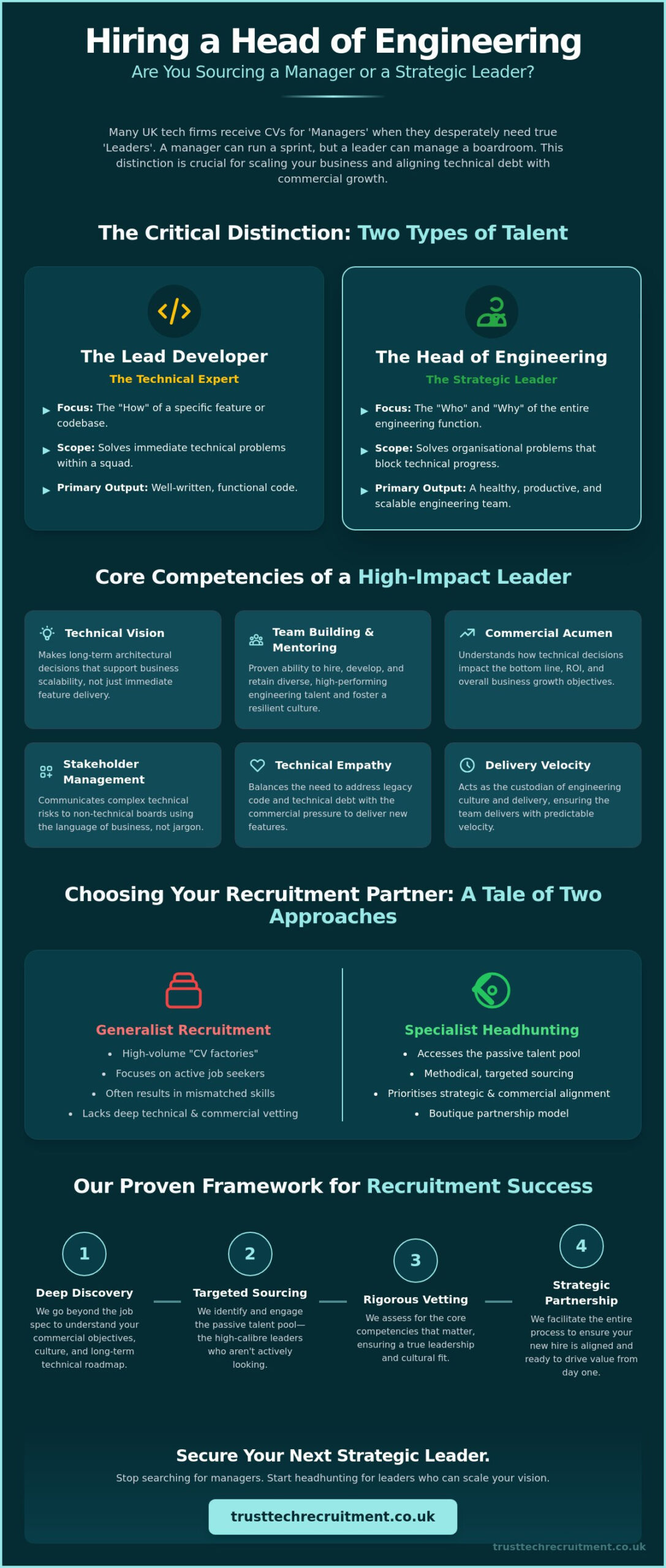
Distinguishing between a Lead Developer and a Head of Engineering is vital for any scaling business. Whilst a Lead Developer remains deeply technical, focusing on the “how” of a specific feature or codebase, a Head of Engineering focuses on the “who” and the “why.” They move away from the keyboard to concentrate on organisational design, resource allocation, and the long-term scalability of the technical department. A Lead Developer solves technical problems; a Head of Engineering solves the problems that prevent the team from solving technical problems.
This hire serves as the essential bridge between the CTO and the wider engineering teams. The CTO sets the vision and the technical direction, but the Head of Engineering makes that vision a reality through operational excellence. They are the ones who manage technical debt, ensure team retention remains high, and foster a culture of accountability. Without this role, a CTO often becomes bogged down in day-to-day management, losing the space needed for true innovation.
The Strategic Scope of the Role
Balancing a technical roadmap with commercial objectives requires a rare blend of skills. The Head of Engineering must manage budgets and allocate resources across various departments, ensuring that every pound spent aligns with the company’s growth targets. They don’t just deliver features; they deliver predictable velocity. The Head of Engineering acts as the primary custodian of engineering culture and delivery velocity.
When Your Organisation Needs a Dedicated Recruitment Strategy
Recognising the point where you have outgrown the “Engineering Manager” tier is a turning point for any tech-led business. This transition usually happens when your focus shifts from individual team performance to the design of the entire engineering organisation. At this level, generalist job boards often fail to attract the right calibre of leader because the most successful candidates aren’t actively looking for work. Instead, businesses often turn to specialist headhunting to access the passive talent pool. Relying on high-volume CV factories for such a critical hire often results in a mismatch of expectations and stakeholder management skills.
Core Competencies to Evaluate in Engineering Leadership
Identifying the right candidate requires looking far beyond a list of programming languages. Whilst an Engineering Manager might focus on the immediate health of a single squad, a Head of Engineering must possess the foresight to shape an entire department. This distinction is where many generalist recruiters fail. They often prioritise the technical stack over the leadership soft skills that actually drive business value in head of engineering recruitment. You aren’t just looking for a coder who can manage; you’re looking for a strategist who can build a sustainable, high-performing engineering function.
Effective head of engineering recruitment hinges on identifying a specific set of Core Competencies to Evaluate, starting with technical vision. A high-calibre candidate must demonstrate the ability to make long-term architectural decisions without getting lost in the weeds of daily coding. They need a proven track record in hiring and mentoring diverse teams to ensure that the engineering culture remains resilient as the organisation scales. A true leader understands that their primary output is no longer code, but the health and productivity of the engineers they lead.
Commercial acumen is equally critical. A strategic leader understands how technical decisions impact the bottom line and ROI. They must be adept at stakeholder management, possessing the ability to communicate complex technical risks to non-technical founders or boards in a way that facilitates informed decision-making. They should be able to explain why investing in infrastructure today will prevent a total system failure in six months, using the language of business risk rather than technical jargon.
Vetting for Cultural and Technical Alignment
Assessing “Technical Empathy” is a vital part of the vetting process. You need to know how they handle the inherent tension between addressing legacy code and delivering shiny new features. Their approach to DevOps maturity and engineering excellence will dictate your delivery velocity for years to come. During high-growth phases, leadership resilience becomes the ultimate differentiator. Ask them about a time they had to scale a team by 50% in a year; their answer will reveal more about their organisational design skills than any technical test ever could.
The “Commercial Engineer” Mindset
The best candidates view code as a tool to achieve a business objective. They are comfortable saying “no” to technical perfection if it means achieving market speed and capturing value. They prioritise “good enough” for the current stage of the company whilst maintaining a path for future improvement. At TrustTech, our screening process is designed to uncover these specific traits. We ensure you meet leaders who prioritise delivery over dogmatism. If you are looking for guidance on your next hire, our permanent tech recruitment experts can help refine your search criteria and find the leader your business deserves.
Specialist Headhunting vs. Generalist Recruitment
Generalist recruitment often operates as a volume game. In the context of head of engineering recruitment, however, volume is the enemy of quality. High-volume platforms often inundate hiring managers with CVs that lack the strategic depth required for leadership. This “Signal vs. Noise” problem is particularly acute in the tech sector, where a keyword match on a CV does not equate to the ability to lead a department. Sifting through hundreds of irrelevant applications wastes the time of technical founders and CTOs who should be focused on product delivery.
The reality is that 90% of the best Heads of Engineering are “passive” candidates. These individuals aren’t browsing job boards or responding to automated LinkedIn messages. They are successfully leading teams elsewhere and require a compelling reason to consider a move. Accessing this calibre of talent requires a deep network within the UK SaaS and tech ecosystem. It requires a partner who understands the nuances of the market and can engage in high-level peer-to-peer conversations. A robust approach to software engineering recruitment that goes beyond keyword matching is essential to reach these high-performing individuals before your competitors do.
Risk mitigation is perhaps the most significant advantage of a specialist approach. A “bad hire” at this level is a catastrophic expense. When you factor in the disruption to the technical roadmap, the potential for team attrition, and the cost of a second search, the true cost of a failed leadership hire can reach 3x the candidate’s base salary. Specialist recruiters reduce this risk by applying a rigorous vetting process that goes beyond technical skills to assess leadership resilience and commercial alignment.
The Limitations of Internal Sourcing
Internal HR teams are often excellent at high-volume hiring but may lack the technical nuance to vet a senior engineering leader effectively. They might struggle to distinguish between someone who merely manages a process and someone who can architect an entire organisation. This often forces founders to spend hours personally sourcing on LinkedIn, a significant time-cost that takes them away from core business growth. A specialist partner acts as a brand ambassador, representing your vision to high-value talent with the credibility that internal teams sometimes lack.
Market Mapping and Tailored Outreach
Finding the right leader requires sophisticated market mapping. This process involves identifying high-performing talent at competitor firms and understanding their specific motivations. For a Head of Engineering, the narrative must focus on the challenge and the scope of impact rather than just the salary. TrustTech utilises niche industry knowledge to access “unreachable” candidates by crafting bespoke outreach that resonates with their career goals. We don’t just wait for talent to find you; we proactively identify the individuals who will drive your business forward.
The Recruitment Process: A Framework for Success
Consistency in head of engineering recruitment is only possible through a structured, multi-phase framework. A haphazard approach often leads to “hiring in your own image” rather than hiring for the specific needs of the business. The process must begin with Deep Discovery. This phase isn’t about listing required technologies; it’s about defining the specific problems the new leader needs to solve, such as reducing technical debt or scaling a team from 20 to 100 engineers. Without this clarity, the search will lack the precision required to attract high-calibre talent.
Phase 2 involves targeted sourcing, where we leverage niche networks and our permanent tech recruitment expertise to reach the passive talent pool. Once a shortlist is established, Phase 3 focuses on multi-stage vetting. This goes beyond a simple technical assessment to include leadership profiling and cultural fit interviews. We look for evidence of resilience and the ability to mentor diverse teams under pressure. Finding the right person is only half the battle; the later stages of the process are where the most critical work happens.
Phase 4, offer management, is particularly complex in the UK market. Navigating three-month notice periods and aggressive counter-offers requires a delicate, transparent approach. We also address IR35 considerations early in the conversation to prevent any late-stage complications. Finally, Phase 5 provides onboarding support. The transition from candidate to leader requires a clear roadmap for the first 90 days to ensure the new hire is set up for long-term success.
Navigating IR35 and Contract Options
There are times when a permanent hire isn’t the immediate answer. If your organisation is undergoing a rapid transition or needs to accelerate a specific technical project, IR35-compliant contract recruitment offers a flexible alternative. This allows you to bring in interim leadership to stabilise a department or manage a specific delivery phase whilst you conduct a search for a permanent successor. Ensuring compliance is vital, and our team provides the necessary guidance to manage these roles within UK regulations.
Interviewing for Leadership
Effective interviewing for this role requires moving beyond the traditional coding test. Instead, we recommend scenario-based leadership interviews that force candidates to demonstrate their decision-making process in real-world situations. You might involve the existing engineering team in a “meet the team” session, but this should be used to gauge chemistry rather than to grant veto power. The final interview should focus exclusively on strategic alignment and the candidate’s long-term vision for the engineering department.
Our team at TrustTech provides the software engineering recruitment expertise needed to manage every stage of this complex journey with precision and care.
Securing Your Next Leader with TrustTech Recruitment
TrustTech Recruitment operates on a simple principle: quality over quantity. In the nuanced field of head of engineering recruitment, we don’t believe in the “post-and-pray” methodology used by generalist agencies. Instead, we act as a strategic guide, ensuring that every candidate we present has been meticulously vetted for both technical excellence and commercial alignment. Our boutique approach allows us to focus on the specific needs of innovative UK organisations, providing a level of service that larger firms simply cannot replicate.
Our expertise isn’t limited to a single silo. By maintaining deep specialisms in Data & BI Recruitment and Marketing Recruitment, we gain a holistic view of the modern tech stack. We understand how a Head of Engineering must interact with data architects and growth marketers to drive a business forward. This cross-functional knowledge ensures that the leaders we place are equipped to handle the complexities of a scaling tech department, including the growing need for recruitment for DevOps engineers who can support continuous delivery and infrastructure at scale. We focus on the precision of the fit, rather than the volume of the CVs.
A Partnership Built on Transparency
We understand that hiring a senior leader is a significant commitment. It’s a high-stakes decision that impacts your roadmap for years. That’s why our process is designed to be entirely transparent and risk-free. We value long-term alignment over quick wins, focusing on the peace of mind that comes from a proven, methodical approach. Our goal is to create a partnership where success is mutual. We take the time to understand your engineering culture, ensuring that the candidates we source aren’t just technically capable, but are also a perfect fit for your team’s values and long-term vision.
Ready to Scale Your Engineering Department?
The first step in securing your next leader is a confidential consultation to map your specific requirements. We go beyond the standard job description to identify the “hidden” talent pool within your niche. By leveraging our extensive network and specialist headhunting techniques, we reach high-calibre individuals who are not actively seeking new roles but are open to the right challenge. This proactive approach is what allows us to secure leaders who can truly bridge the gap between technical debt and business growth.
If you’re ready to transform your engineering leadership, our team is prepared to guide you through the process. Contact TrustTech Recruitment today to discuss your Head of Engineering search and discover how a strategic partnership can improve your hiring outcomes.
Scaling Your Technical Leadership with Confidence
Securing a leader who can balance technical excellence with commercial growth is the most significant investment a scaling tech firm will make. It’s about more than just filling a vacancy; it’s about finding a partner who understands your long-term roadmap. By focusing on strategic competencies rather than just technical stacks, you ensure your new hire can navigate complex stakeholder relationships and manage technical debt effectively. Moving away from volume-based generalist agencies allows you to access the high-calibre candidates who form the passive talent pool. A structured, multi-stage process is essential for mitigating the risks associated with senior leadership hires.
TrustTech Recruitment serves as a specialist UK-based recruitment consultancy for high-growth SaaS and tech firms. Our expertise in both IR35-compliant contract and permanent tech recruitment ensures your search is handled with precision and full regulatory compliance. We act as your strategic guide, providing the industry-literate vetting required for successful head of engineering recruitment. When you’re ready to bridge the gap between architectural vision and business delivery, we’re here to support your growth.
Partner with TrustTech for your next strategic engineering hire and gain the peace of mind that comes from a proven, meticulous process. We look forward to helping you build a resilient leadership team that drives your organisation forward.
Frequently Asked Questions
What is the typical salary for a Head of Engineering in the UK in 2026?
Salaries for a Head of Engineering vary by region and company scale, with roles in the Central Belt of Scotland typically ranging from £85,000 to over £110,000. In London and the South East, compensation is often significantly higher, frequently exceeding £140,000 for experienced leaders in high-growth sectors. These packages increasingly include equity, performance bonuses, and a focus on total compensation that covers well-being and flexible working arrangements.
How long does it usually take to recruit a high-calibre Head of Engineering?
A successful search for a senior engineering leader generally takes between 8 and 12 weeks from the initial briefing to a signed offer. Whilst the average UK time-to-hire is between 36 and 42 days, leadership roles require a more meticulous headhunting approach to reach passive talent. Factoring in a three-month notice period, businesses should plan their leadership requirements at least six months in advance of the desired start date.
Should I hire a Head of Engineering or a VP of Engineering?
The choice depends on the maturity of your organisation and the specific problems you need to solve. A Head of Engineering is usually the primary choice for scaling firms that need someone to focus on delivery, people management, and the software development lifecycle. A VP of Engineering often takes a more strategic, board-level view of the entire technical organisation. For most UK startups and SMEs, a Head of Engineering provides the operational leadership needed to scale effectively.
How do I ensure a Head of Engineering hire is IR35 compliant if they are on a contract basis?
Ensuring compliance requires a formal Status Determination Statement (SDS) to assess whether the engagement sits “inside” or “outside” the IR35 legislation. This assessment must consider the reality of the working relationship, focusing on factors like the right of substitution and the degree of control the client has over the contractor. TrustTech provides expert guidance on IR35 recruitment to help you navigate these regulations whilst securing interim leadership.
What are the common mistakes when hiring an engineering leader for a SaaS startup?
The most frequent error is over-prioritising technical stack proficiency at the expense of leadership and commercial acumen. Startups often hire “Managers” who can track tickets but lack the “Leader” mindset required to design an organisational structure that supports rapid scaling. Another common mistake is failing to vet for stakeholder management skills, which are essential for communicating technical risks to non-technical founders and boards.
How do specialist tech recruitment agencies vet for technical skills at the leadership level?
Specialist agencies move beyond standard coding tests, focusing instead on scenario-based interviews that evaluate architectural decision-making and technical vision. We assess how a candidate handles technical debt, prioritises roadmaps, and mentors their team through high-pressure delivery cycles. This ensures the candidate possesses the “Technical Empathy” needed to lead effectively without needing to be the one writing the daily code.
Can TrustTech help with both permanent and contract engineering leadership roles?
Yes, TrustTech provides dedicated support for both permanent and contract leadership positions within the UK tech ecosystem. We understand that different business challenges require different hiring models, whether you need a long-term strategic lead or an interim expert for a specific project. Our focus on head of engineering recruitment ensures that we have a vetted network of professionals available for either engagement type.
What notice periods should I expect for senior engineering leaders in the UK?
Senior engineering leaders in the UK typically have a notice period of three months, though this can occasionally be longer in highly specialised or executive-level roles. It’s important to manage these timelines carefully during the offer management phase to ensure a smooth handover. We work closely with candidates to navigate these periods and, where possible, negotiate earlier release dates to meet your technical roadmap requirements.