
SMEs win the tech talent war not by matching corporate salaries, but by offering the mission-critical impact and agility that global giants simply cannot replicate. Whilst the competition for specialists in Software Engineering and Data is fierce, success depends on a refined tech hiring strategy for SMEs that prioritises precision over volume. You’ve likely felt the frustration of losing a promising candidate to a remote-first enterprise after a three-week interview process, or perhaps you’ve struggled to vet complex technical skills without an internal expert to lead the way.
It’s exhausting to watch top-tier talent slip away because your process feels sluggish compared to the market’s pace. We understand that for a growing business, every hire is a high-stakes investment that demands certainty and speed. This guide provides a comprehensive, template-driven framework designed specifically for the 2026 landscape. You’ll learn how to build a repeatable process that slashes time-to-hire, gain access to niche talent pools in BI and Data, and finally determine when to utilise contract versus permanent staff for maximum flexibility.
Key Takeaways
- Developing a successful tech hiring strategy for SMEs requires a shift from bureaucratic screening to an agile, candidate-centric approach that prioritises speed.
- Learn how to articulate an “Impact-First” value proposition to attract elite engineers who value visible influence over corporate anonymity.
- Discover how to compress your hiring timeline from weeks to days by implementing agile technical assessments that respect candidate time whilst ensuring high-quality vetting.
- Understand the strategic balance between permanent hires for core IP and contract recruitment for project-based scaling to maintain operational flexibility.
- Explore the “Signal over Noise” methodology to reduce recruitment fatigue by focusing on a curated selection of three highly aligned technical specialists rather than dozens of mediocre CVs.
What is a Tech Hiring Strategy for SMEs in 2026?
A tech hiring strategy is a structured blueprint for identifying, attracting, and retaining specialised technical professionals. It serves as a proactive alignment of engineering needs with business growth milestones. For a smaller business, this framework isn’t just about filling seats; it’s about securing the specific expertise required to scale a product or secure a digital infrastructure without the overheads of a global enterprise.
Success in this area differs significantly from a standard recruitment process because it requires deep technical vetting and a nuanced understanding of the UK’s niche talent market. Whilst generalist agencies might focus on volume, a refined tech hiring strategy for SMEs prioritises speed and candidate experience over bureaucratic screening layers. In a market where elite developers are often balancing multiple offers, a sluggish process is the quickest way to lose top-tier talent. Clarity and momentum are your greatest competitive advantages.
The Evolution of the UK SME Talent Market
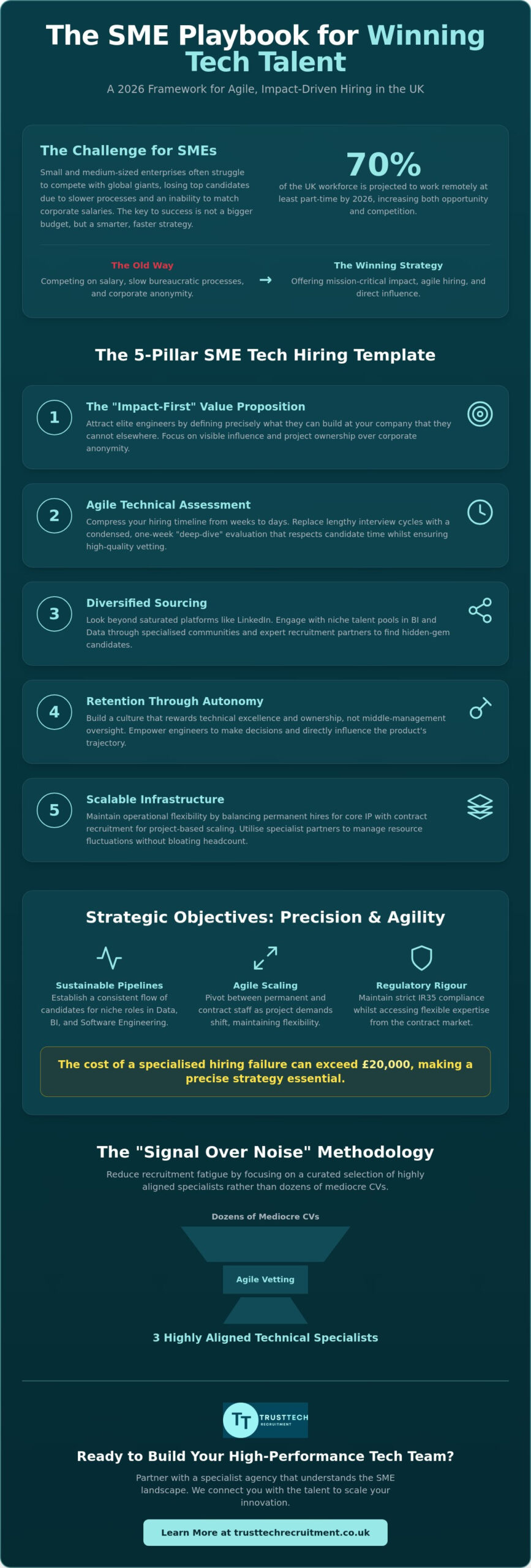
By 2026, the shift to hybrid and remote-first work has fundamentally reshaped the talent pool. Research indicates that 70% of the workforce is projected to work remotely at least part-time by the end of this year. This change has expanded the reach for UK SMEs, allowing them to source talent far beyond their local postcode. However, it has also increased competition from global enterprises. To win, SMEs are now positioning themselves as the preferred choice for engineers seeking “impact” over “cog-in-the-machine” roles. Developers in 2026 are increasingly drawn to businesses where their code directly influences the company’s trajectory and where they can avoid the stagnation often found in larger corporate structures.
Core Objectives of a Technical Strategy
The primary goal of a robust tech hiring strategy for SMEs is to reduce the “Cost of Vacancy.” For a small team, a missing lead developer or data scientist can stall a roadmap for months. Industry data from March 2026 suggests the cost of a specialized hiring failure can exceed £20,000, making precision essential. Your strategy should focus on:
- Sustainable Pipelines: Establishing a consistent flow of candidates for niche roles in Data, BI, and Software Engineering.
- Agile Scaling: Ensuring you can pivot between permanent staff and the contract market as project demands shift. Using contractors to scale engineering teams as an “Elastic Engineering” strategy allows SMEs to respond to project surges without over-committing to permanent headcount.
- Regulatory Rigour: Maintaining strict IR35 compliance whilst accessing the flexible expertise found in the contract recruitment sector.
By treating recruitment as a strategic function rather than an administrative task, you ensure that every new hire contributes directly to long-term stability and innovation.
The 5-Pillar SME Tech Hiring Template
A successful tech hiring strategy for SMEs relies on a foundation of five core pillars. These elements transform recruitment from a reactive scramble into a repeatable, high-performance process. By following this framework, your business can bypass the bureaucracy that slows down larger competitors and secure talent with precision.
- Pillar 1: The “Impact-First” Value Proposition: You must define exactly what a developer can build at your company that they cannot build elsewhere.
- Pillar 2: Agile Technical Assessment: Replace four-week interview cycles with a condensed one-week “deep-dive” evaluation.
- Pillar 3: Diversified Sourcing: Look beyond saturated platforms like LinkedIn to engage with niche communities and specialised partners.
- Pillar 4: Retention through Autonomy: Build a culture that rewards technical excellence and ownership rather than middle management oversight.
- Pillar 5: Scalable Infrastructure: Utilise an IT project recruitment agency UK to manage fluctuating resource requirements without bloating your permanent headcount.
Defining Your Technical Value Proposition (TVP)
Top-tier engineers in 2026 aren’t just looking for a “competitive salary”; they’re looking for project ownership and a modern tech stack. Your TVP should highlight the “problem-solving” allure of your specific environment. Whilst many organisations look to six strategies for hiring tech talent to bridge the gap between sectors, SMEs win by offering direct influence over the roadmap. Craft your job descriptions to speak the language of engineers. Focus on the technical challenges they’ll solve rather than a dry list of HR requirements. If you’re unsure how your current offer compares to the market, consulting with a specialist tech recruitment partner can provide the necessary benchmarking data.
Streamlining the Technical Interview
Speed is your greatest asset. High candidate drop-out rates often stem from unnecessary interview stages that fail to provide additional insight. To improve your “Signal-to-Noise” ratio, identify the three core competencies that actually matter for the role. Instead of generic whiteboard tests, utilise pair programming sessions or architectural discussions that mimic real-world tasks. This approach respects the candidate’s time and provides a clearer picture of their practical abilities. Implement a strict “48-hour feedback” rule for every stage. If you can’t decide within two days, your process is likely too complex. Momentum builds trust and ensures you don’t lose elite talent to faster-moving competitors who are ready to sign immediately.
Benchmarking vs. Big Tech: How SMEs Compete for Talent
Competing for technical talent in 2026 does not require a Silicon Valley budget. Whilst industry giants utilise “golden handcuffs” and massive base salaries to attract candidates, they often struggle with bureaucratic inertia and a lack of individual agency. A successful tech hiring strategy for SMEs focuses on the areas where enterprises are weakest: speed, autonomy, and visible impact. By positioning your business as a place where code translates directly into company growth, you appeal to a specific demographic of high-performers who are tired of being a small cog in a massive machine.
The numbers support this shift in candidate priorities. In 2026, 72% of developers cite work-life balance and autonomy as more important factors than their base salary. This provides a significant opening for smaller firms that can offer flexible working arrangements and genuine project ownership. You aren’t just selling a job; you’re selling the opportunity to shape a product’s DNA. This “Culture and Code” alignment ensures that the specialists you hire are committed to the mission, not just the next pay rise. It’s about creating an environment where technical excellence is the default and where developers have the freedom to choose the best tools for the job without seeking approval from a global steering committee.
The Agility Advantage in Recruitment
A flat hierarchy is your most potent weapon. In many corporate environments, an offer must pass through multiple layers of HR, finance, and department heads. An SME can make a definitive offer whilst a corporate competitor is still trying to find a slot for a second technical interview. This momentum is vital for securing elite talent. We often recommend incorporating “Founder Access” in the final stages. Speaking directly with the person who built the business provides a level of transparency and excitement that a corporate recruiter cannot match. Utilising expert tech staffing solutions allows you to level the playing field, giving you access to the same talent pools as industry giants without the enterprise-level overheads.
Niche Specialisation over Generalist Volume
Instead of hiring broad generalists, SMEs should target “T-shaped” developers who possess deep expertise in one area but can collaborate across the full stack. This is particularly effective for Data & BI professionals who want to see their insights drive immediate business decisions rather than getting lost in a quarterly report. Building this core engineering DNA requires a commitment to long-term growth. Investing in permanent tech recruitment services ensures that your most critical intellectual property remains in-house, creating a stable foundation for future innovation. By focusing on quality and alignment, you build a team that is resilient, versatile, and deeply invested in your success. These individuals thrive in environments where they can wear multiple hats, contributing to architectural decisions one day and refining a data pipeline the next.
Implementation: Building Your Tech Stack and Process
Executing a tech hiring strategy for SMEs starts with an honest audit of your current technical debt and future roadmap. You cannot hire effectively if you don’t know which gaps are critical for your next product milestone. Technical debt in this context isn’t just about legacy code; it’s about the missing expertise that prevents your team from innovating. Once you identify these needs, the next step involves choosing between permanent hires for core IP and contractors for project-based scaling. This decision dictates your budget allocation and long-term stability. It ensures you aren’t over-committing to salaries when a flexible resource might be more efficient for a short-term sprint.
Don’t overlook the power of your existing team. Establishing a “Culture of Referrals” amongst your engineering staff often yields the most aligned candidates. Developers prefer working with people they trust, and a referral programme can significantly reduce your cost-per-hire whilst increasing retention. Finally, select a recruitment agency for tech firms that understands your specific niche rather than a generalist provider. A specialist partner will have existing relationships with the talent you need and can vet for specific technical nuances that internal HR teams might miss. This partnership allows your leadership to focus on product development rather than sifting through unsuitable CVs.
Permanent vs. Contract: The Growth Decision Matrix
Permanent staff are essential for building long-term architecture and retaining company knowledge. They are the guardians of your core product. Conversely, contractors are ideal for handling sudden project surges or providing niche skills for specific projects. For a deeper understanding of how to implement this model effectively, our guide on using contractors to scale engineering teams covers the practicalities of building a flexible, high-performance workforce whilst maintaining rigorous quality standards. In 2026, navigating IR35 compliance remains a priority for UK SMEs to ensure that flexible scaling remains risk-free. If you need help determining the right mix for your current roadmap, you can speak with our strategic consultants to design a tailored workforce plan.
Optimising the Candidate Experience
A “Candidate Journey” audit is the most effective way to identify where talent drops out of your funnel. If you notice a high exit rate after the initial screening, your technical test might be the culprit. Ensure your assessments are respectful of the candidate’s time whilst remaining rigorous. Transparent communication regarding salary, equity, and remote-work expectations is non-negotiable. Treating candidates with the same respect as your clients improves your reputation amongst the developer community, making future recruitment significantly easier.
Partnering for Scale: The TrustTech SME Methodology
TrustTech Recruitment operates as a dedicated extension of your internal team rather than a distant external vendor. We understand that for a growing business, time is the most precious resource. Our methodology centres on “Signal over Noise.” Instead of inundating your inbox with thirty mediocre applications, we provide three high-quality, meticulously vetted CVs. This approach respects your schedule and ensures that every interview you conduct is a step toward a successful hire. By focusing on precision, we help you implement a tech hiring strategy for SMEs that is both sustainable and highly efficient.
Our expertise is rooted in deep niche networks across Software Engineering, Data & BI, and Marketing. These aren’t just lists of names; they’re active communities of specialists we’ve engaged with over years of partnership. This depth allows us to move beyond surface-level keywords to find candidates whose technical alignment and cultural fit are beyond reproach. We mitigate the risk of a bad hire by conducting thorough technical and behavioural assessments before a candidate ever reaches your desk. This rigour protects your culture and your bottom line from the significant costs of recruitment failure discussed throughout this framework.
Specialist Knowledge for Innovative Organisations
We choose to focus exclusively on tech and marketing because these sectors drive modern business growth. This specialisation provides us with deeper market insights that generalist agencies simply cannot offer. Our commitment to tech recruitment for startups and SMEs across the UK ensures we understand the specific pressures of scaling an engineering team. We manage the heavy lifting of sourcing and initial vetting so your founders can focus on building the product and driving the vision. You get the benefit of a high-end recruitment function without the enterprise-level overheads.
Next Steps for Your 2026 Hiring Plan
Refining your tech hiring strategy for SMEs is an iterative process that requires constant alignment with the market. We recommend starting with a 30-minute talent audit with one of our specialists to identify immediate gaps in your roadmap. During this session, we’ll help you refine your Technical Value Proposition to ensure you’re attracting the top 5% of the UK’s technical talent pool. Whether you’re looking for a lead data scientist or a fleet of contract developers, we provide the strategic guidance needed to scale with confidence. Ready to build? Contact TrustTech Recruitment today for a bespoke hiring strategy and take the first step toward securing your technical future.
Securing Your Technical Future in 2026
Building a high-performing engineering team doesn’t require the vast resources of a global enterprise. It requires a commitment to speed, transparency, and a refined tech hiring strategy for SMEs that prioritises the candidate experience. By leveraging your agility and offering roles defined by impact rather than bureaucracy, you can successfully compete for the UK’s most sought-after technical specialists.
Whether you’re looking to anchor your core IP with permanent Software Engineering talent or scale rapidly through IR35-compliant contract solutions, the right partnership makes all the difference. We provide a boutique service with national UK reach, specialising exclusively in Software Engineering and Data BI. Our methodology ensures you receive a curated selection of elite talent, allowing you to focus on innovation whilst we handle the complexities of the market.
Partner with TrustTech to build your 2026 engineering team and transform your recruitment into a strategic growth engine. Your next breakthrough hire is closer than you think.
Frequently Asked Questions
How long should a tech hiring process take for an SME?
A tech hiring process for an SME should ideally take between 10 and 14 days from the initial interview to a formal offer. Speed is your primary advantage over larger competitors who often take four weeks or more. If your process extends beyond 21 days, you risk losing top-tier candidates to faster-moving organisations that prioritise momentum.
How do we compete with Big Tech salaries as a small business?
Compete by offering equity, rapid career progression, and a “Technical Value Proposition” that emphasises individual impact. Whilst you may not match enterprise-level base salaries, you can offer project ownership that industry giants cannot replicate. Developers in 2026 prioritise autonomy and work-life balance, which are areas where SMEs naturally excel over corporate environments.
What is the best way to test technical skills without a large dev team?
Utilise pair programming sessions or architectural discussions that focus on real-world problem-solving rather than abstract puzzles. If you lack internal expertise, partnering with a specialist recruiter who provides deep technical vetting can ensure candidate quality. This approach provides a clear signal of a candidate’s practical abilities without requiring a large internal engineering team to lead the process.
Should an SME hire permanent staff or contractors for their first tech build?
SMEs should generally hire a permanent lead to anchor their core IP whilst using contractors to handle the initial build’s heavy lifting. This strategy ensures that long-term product knowledge remains within the business whilst providing the flexibility to scale down once the primary project is complete. It balances long-term stability with short-term operational efficiency.
What are the most in-demand tech skills for UK SMEs in 2026?
The most in-demand skills for UK SMEs in 2026 include Software Engineering with a focus on cloud-native architecture, Data & BI for real-time decision making, and AI integration. Specialists who can navigate the intersection of engineering and data are particularly valuable. These versatile professionals provide the technical breadth required to thrive in a lean, agile team. For SMEs looking to elevate their data function, understanding the landscape of head of data recruitment UK is essential to securing the strategic leadership that can translate these capabilities into commercial outcomes.
How can we improve our employer brand if we are a relatively unknown startup?
Focus on radical transparency regarding your technical roadmap and provide direct access to the founders during the interview process. Unknown startups build an employer brand by showcasing the specific, mission-critical challenges a new hire will solve. Use your digital presence to highlight your modern tech stack and the engineers already driving your innovation forward.
What is the role of a recruitment partner in an SME tech hiring strategy?
A specialist partner acts as an extension of your team, providing the niche networks and market intelligence required for a successful tech hiring strategy for SMEs. They manage the heavy lifting of sourcing and vetting, delivering a curated shortlist of high-quality candidates. This allows your leadership to focus on product development rather than administrative screening and unsuitable CVs.
How does IR35 affect SME hiring of technical contractors?
IR35 regulations require SMEs to ensure the correct tax status for their technical contractors to avoid significant financial liabilities. A robust tech hiring strategy for SMEs includes working with partners who provide IR35-compliant contract solutions. This ensures your business can access flexible expertise for project-based scaling whilst remaining fully compliant with current UK tax legislation.